|
0 registered (),
353
Guests and
3
Spiders online. |
|
Key:
Admin,
Global Mod,
Mod
|
|
30763 Members
78 Forums
19416 Topics
187031 Posts
Max Online: 2435 @ 12/29/25 09:52 AM
|
|
|
#121301 - 02/27/08 10:22 PM
 Re: Albino Child and other genetic new traits
[Re: Robert1220]
Re: Albino Child and other genetic new traits
[Re: Robert1220]
|

Adviser
Registered: 02/27/08
Posts: 51
|
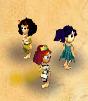
My tribe (has albino- like kid): (I hope this works) He had white hair when he was 2  Now it's grey-ish... 
Edited by Rachel =] (02/28/08 03:40 AM)
_________________________
~Rachie 
|
|
Top
|
|
|
|
|
#121319 - 02/28/08 12:47 AM
Re: Albino Child and other genetic new traits
[Re: Rachel =]]
|
Senior Uber-Member

Registered: 09/22/06
Posts: 1709
Loc: Houston, TX
|
he will have white hair all of his life. It is simply one of the villager designs in the game
_________________________
Why is it that if someone tells you that there are 1 billion stars in the universe you will believe them,
but if they tell you a wall has wet paint you will have to touch it to be sure?
|
|
Top
|
|
|
|
|
#121379 - 02/28/08 04:22 PM
Re: Albino Child and other genetic new traits
[Re: Robert1220]
|
Newbie
Registered: 12/17/07
Posts: 8
|
well i have all redheads.... so did i, 106 villagers all with red hair, but then a group of kids with blonde hair turned up so soon as they got old enough i got them parenting so now its blondes and redheads. my other village they all had dark hair, but the gong granted fertility and all the females of child bearing age became pregnant so now i have quite a mix. what i have had a few times is two fair skinned light haired parents having a child with very dark skin with red hair.
|
|
Top
|
|
|
|
|
#130013 - 04/13/08 01:05 AM
Re: Albino Child and other genetic new traits
[Re: Tmac]
|
Expert

Registered: 03/28/08
Posts: 105
Loc: The 1st state!Delaware!
|
What color hair plus what color hair=Blonde hair in VV2?I want to know cuz im blonde and have always wanted to have a all blonde tribe!
_________________________
Cole+Dude+1+0+1=ColeDude101
Im playing VV3 again,and I'm going to be more active on here now!
|
|
Top
|
|
|
|
|
#132243 - 04/20/08 02:01 AM
Re: Albino Child and other genetic new traits
[Re: SpecialPrincess]
|
Expert

Registered: 04/19/08
Posts: 145
|
Hi, I just joined. I think I may have figured out the key to determining which child will come from which parents. I've been working on this, and found a pattern. I decided to join to share it with others.
There are 30 females and 30 males. The files which show them are female_heads.png and male_heads.png.
By opening A COPY of those files, I numbered each "head" starting with 1 at the top, going to 30 at the bottom. I did this for both, the female and male, heads.
What I noticed is that the child produced is a basic average between the two parents. For example, if one parent is head #10 and the other parent is head #20, they will most likely produce a child with a head #15. Sometimes the number goes up a notch or down a notch, but it's usually very close to the middle.
This is why the black haired and blonde haired heads begin to disappear with red haired heads taking over. The red heads are in the middle which will be the usual place for the average of the two parents UNLESS great care is taken to ensure both parents have the same hair color (black or blonde).
Every now and then a wild card appears. Some of them I was able to figure out that it was the average, not of the numbers in between the two parents, but the other numbers. For example, mixing parents #20 and #30 would normally be written as (20+30)/2 = 25. That's the normal average between the two numbers. However, it's possible to use the other numbers. Think of the numbers going in a circle:
(Edited to explain that the BBcodes aren't showing up very well below. Look for the numbers in BOLD text and the middle of those numbers will be in ITALICS. I'll add underlines and stars to make it easier to see.)
The normal average would include the inside numbers. So (20+30)/2 = 25 would look like this:
1 2 3 4 5 6 7 8 9 10 11 12 13 14 15 16 17 18 19 20 21 22 23 24 *25* 26 27 28 29 30
However, the other numbers could be used. That would look like this:
1 2 3 4 5 6 7 8 *9 10* 11 12 13 14 15 16 17 18 19 20 21 22 23 24 25 26 27 28 29 30
To determine this outcome, you simply divide in half the opposite numbers from above. So 19/2 = 9.5. This means the child will have an equal chance of being head #9 or #10. These "outside" numbers explains many of the apparent random children that are sometimes seen.
The larger the distance between the numbers, the larger the possibility for the child to be 1 or 2 heads above or below the actual average. So if you have parents #10 and #12, it's very likely you'll get #11, but you may get another #10 or #12. But when you have parents #10 and #20, the average would indicate the child would be #15, but it could be anywhere between those numbers. So a #12 or #18 is also possible. Not as common, but likely.
I've started keeping a chart of which parents produce which child, both by pictures and their corresponding numbers, and so far with about 25 sets, the average between the parents (give or take 1 or 2) is always accurate. It's so accurate that I can now pre-determine which child or possible children may result.
There may be some heads that are wild-cards, such as possibly the albino woman. I don't know. I started tracking this after I realized I was down to only 2 blonde males and 1 black male with all the others being shades of brown/red/purple. I'm trying to get the blondes and blacks back. So I'm trying to use the average technique to do this. For the blondes, I put parents with the largest numbered heads together. If I breed a 15 with a 25, I'll usually get a 20. Then I can breed the 20 with the 25, creating a 22 or 23. If I can continue this AND have the luck of a wild card blonde (or the albino woman), then I can bring back the blondes. I'll do the same for the blacks.
I'm also going to work with using the "other" numbers to try to get a blonde or black back. If the most blonde I have is a 25, I try to breed it with a 5. The normal average of those will be (5 + 25)/2 = 15. But if the "outside" numbers are used, then I'd have from 25-30 + 1-5, with the outside middle being either a 30 or a 1. I don't know what triggers it to use the "outside" numbers. I'll have to keep breeding and keeping track of the children to see if there's a pattern to determine which set of numbers are used for the average which determines the child.
I hope this isn't too confusing. Just think of the 1 through 30 as a loop. The parents will be two of the numbers. And the numbers between them, either way, can be used to determine the child. It's almost always the normal average, but on occasion, the other numbers are used to get what appears to be a very random child. Only it's not random. It's just the result of using the other set of numbers in the loop.
So far, I have only found 1 parents/child combination which does not follow this pattern. The parents are #9 and #10 with the child being a #18. Obviously, the normal average would be 9.5, making it so either a 9 or 10 child would result. If the "outside" numbers were used (1-8 + 11-30) = (8 + 20) = 28. Divided by 2, you'd get 14. The child is 4 points away from that average which is more than I've seen in all my other calculations. So that one does not fit either average. It could be just a simple larger margin from the average since the averaged numbers are so high, but it's the only 4 point spread from the middle I've seen so far. All others are within 1 to 2 from the average. So I'd expect a 12, 13, 14, 15, or 16, but not an 18.
Sorry this was so long, but it's hard to explain. I hope some of this makes sense the way I've written it. I'll keep tracking the pattern to see what else I can figure out.
Edited by Complexity (04/20/08 02:13 AM)
|
|
Top
|
|
|
|
|
#132247 - 04/20/08 02:08 AM
Re: Albino Child and other genetic new traits
[Re: Complexity]
|
Fan Fiction Enthusiast

Registered: 12/18/07
Posts: 409
Loc: My Imagiantion Roams Freely, N...
|
..................interesting
_________________________
I'm Back!!!!
|
|
Top
|
|
|
|
|
|


 Previous Topic
 Index
Index